
Cathedral City Neighbor Lookup Sources
A Cathedral City neighbors lookup should begin with a known address and a narrow question. Map My County shows physical parcels, surrounding streets, jurisdiction, and available layers. The Riverside assessor roll can identify an owner through the office, while the public web search returns an APN and assessment facts but withholds owner names online. The recorder's party index can trace documents after a parcel produces a name. City permits and code records show activity at a site, not a complete list of people around it.
The block view also has a community layer. Cathedral City publishes public contacts and programs, yet no official comprehensive neighborhood or association membership directory was located. A voter file is restricted and My Voter Status is personal verification. The table separates what each route can show from what it cannot promise.
| Source | What It Shows About a Block | Access |
|---|---|---|
| Map My County | Parcel shapes, streets, adjacent APNs, jurisdiction, and visible map layers | Free interactive map |
| Riverside assessor office | Public owner roll by APN or address, plus assessment and situs facts | In person; online owner suppression |
| Riverside recorder | Recorded owner and document chain for each parcel | Online party index, office, or copy order |
| Cathedral City permits and code | Address activity, applicants, contractors, plans, inspections, or cases | City portal or CPRA request |
| Authorized voter file | Registered voters and geography for an approved statutory purpose | Application, fee, and statutory limits |
| City neighborhood resources | Public contacts and programs, not a member or household roster | City page and department |
An owner, a mailing address, and an occupant are different entries. A parcel can contain several units, a common area, or no private household at all. Read the source's role and date before calling anyone a Cathedral City neighbor.
Map a Cathedral City Neighbor Block
Map My County is the practical starting point for the adjacent-parcel method. Search by address or location, or enter an APN when one is known. The viewer includes a layer list for parcels, jurisdiction, zoning or general-plan information and other visible services. Identify or select tools reveal a parcel, measure tools show distance or area, and print, basemap, zoom, and pan controls help preserve the view used for the search.
- Enter the full Cathedral City address and confirm the marker falls inside the correct parcel polygon.
- Turn on parcel boundaries and identify the target APN, situs, and visible jurisdiction layers.
- Zoom until the side, rear, front, and across-the-street parcels are legible, then click each one.
- Record every neighboring APN and situs address before following the record to the assessor office.
- Use the measure tool for distance, and switch to the Cathedral City street directory when the goal becomes a full named-street chain.
Do not invent a radius. A parcel's shape, a shared drive, a condominium subparcel, or a public strip can change what counts as adjacent. A map is strongest when the screenshot date, visible layers, APNs, and jurisdiction are written down with the result.
Cathedral City Parcel Records Keep Neighbors Straight
An APN is a Riverside County assessment parcel number, commonly displayed as a nine-digit identifier with separators. It identifies land for assessment; it is not a person and it is not a postal delivery point. A situs is the assessed location. A mailing address can be a post-office box, a management address, a trust address, or another property. The assessor search accepts an address or APN, but the public website deliberately does not display owner names.
Revenue and Taxation Code section 408 supports inspection of the owner roll at an assessor office. That makes the remote and counter routes different parts of one neighbor lookup. After an office search supplies a name, the recorder can be searched by grantor or grantee. Recorded documents are not indexed by street address, and an image may contain historical correspondence details that do not establish current residence.
- Parcel
- A mapped piece of assessed land, which may include shared, common, public, or multi-unit property.
- APN
- The assessor's parcel identifier used to connect a map, assessment record, and related county files.
- Situs address
- The location assigned to the assessed site, distinct from a mailing address.
- Legal description
- The deed or map description that helps distinguish land when names or street labels are similar.
Keep the APN with the map date. A split, merge, lot-line adjustment, or common parcel can change the parcel record while a street label remains in use.
Note: A street address can persist while a split, merge, or lot-line adjustment changes the APN used for the next search.
Cathedral City Community Records and Contacts
The community-directory layer adds ways to learn about programs, local memory, and public points of contact. It does not turn an organization into a private roster. The city's community-resource inventory names local groups, while the Cathedral City Historical Society describes photographs, scrapbooks, postcards, articles, and memorabilia. Ask for an intentionally published contact, event notice, or historical publication. Do not infer membership from a name on a flyer.
| Public resource | Useful contact layer | Access path |
|---|---|---|
| Cathedral City Historical Society | Photographs, scrapbooks, postcards, articles, and early-days stories | Society website |
| Agnes Pelton Society | Public community contact and local cultural context | City resource list |
| Cathedral City Senior Center | Public program and service contact | City community-resource list |
| Boys and Girls Club | Public youth-program contact | City community-resource list |
| Big Brothers Big Sisters | Public mentoring and service contact | City community-resource list |
| Braille Institute | Public community-service contact | City community-resource list |
| FIND Food Bank | Public food-assistance contact | City community-resource list |
| AYSO Region 1200 | Public youth-sports contact | City community-resource list |
There is no verified official comprehensive HOA or neighborhood-association membership directory for Cathedral City. Community groups can supply public contact points, not private member lists. The same boundary applies to congregations, clubs, and watch programs unless an organization deliberately publishes an opt-in directory.
Note: A public group contact identifies a way to ask questions, not the names of people who belong to it.
Cathedral City Neighbors and Neighborhood Names
Names used around Cathedral City can describe a planning area, a subdivision, a local tradition, or a marketing label. Recognized names that appear in local and community material include Cathedral Canyon Cove, Cathedral City Cove, Dream Homes, Panorama, Rio Vista, Century Park, and the Downtown or Arts and Entertainment District. They are useful search terms for maps, minutes, newspapers, and historical files, but the name alone does not set a legal boundary.
Verify the boundary and current association status with the city. A parcel near a city edge can carry a Cathedral City mailing label while falling under county or another municipal jurisdiction for permits and code work. The Agua Caliente reservation also covers roughly 28 percent of the city, so land status and the correct custodian can change within a short map view.
For a history question, add the subdivision name and the street's older spelling to a library or archive request. For a current block question, keep the APN and jurisdiction as the controlling identifiers.
Cathedral City Parcel Records Are Not Households
One parcel can represent a single-family site, multiple units, a condominium or common area, a mobile-home setting, a public parcel, or a lot with no current household. The assessor result is about land and assessment. A permit connects a site to an applicant, contractor, engineer, owner shown on a form, scope, inspection, or status. None of those fields creates a complete list of people who live nearby.
City code cases can be address-keyed, but complaint narratives and investigative material may be redacted or withheld. If the online permit service does not expose the needed item, use the city's NextRequest portal or the City Clerk records channel for an existing record. Give the address, record type, department, and date span. The California Public Records Act requires a determination within ten calendar days, with a written extension of up to 14 days for unusual circumstances, but it does not require the city to create a new neighbor list.
Read an applicant as an applicant. A permit, deed, tax row, or recorded notice may connect a person to activity or ownership without showing present occupancy. Protected residents, minors, informal household members, and private utility or delivery customers stay outside an ordinary block map.
Cathedral City Voter Records Stay Restricted
My Voter Status cannot browse a Cathedral City block by street. It is a personal check that asks for first name, last name, date of birth, and the last four digits of a California driver license or ID as prompted. The result can show the requester's registration status, party preference, polling place, and ballot information. It does not reveal a block of names, and ballot choices remain secret.
Elections Code section 2194 permits defined election, scholarly, journalistic, political, and governmental uses, while section 2157 protects driver-license or ID numbers, Social Security numbers, and signatures. An authorized voter-file application must state the requester, purpose, geography, data, delivery method, authorized users, certification, and payment. A protected voter or Safe at Home participant may have a substituted or withheld address. Casual curiosity is not an approved street-browse purpose.
Use the California personal voter-status tool for the requester's own record. For an approved research use, start with the state voter-file request instructions and keep the certified purpose within its limits.
Cathedral City Official Records and Neighbor Tools
Commercial neighbor tools are compilations built from mixed public and purchased data. They may merge people with similar names, lag a source correction, charge for uncertain results, or omit entire groups. Official sources are narrower, but their limits are visible. A good Cathedral City neighbors lookup treats the compilation category as a lead and returns to the source office before making a claim.
When a letter, deed notice, or property claim asks for payment, check the official record first. Riverside County's real-estate fraud guidance explains how to question an unexpected property solicitation and contact the county independently.
Riverside County's real-estate fraud protection resource is an official route for checking a property-related claim.
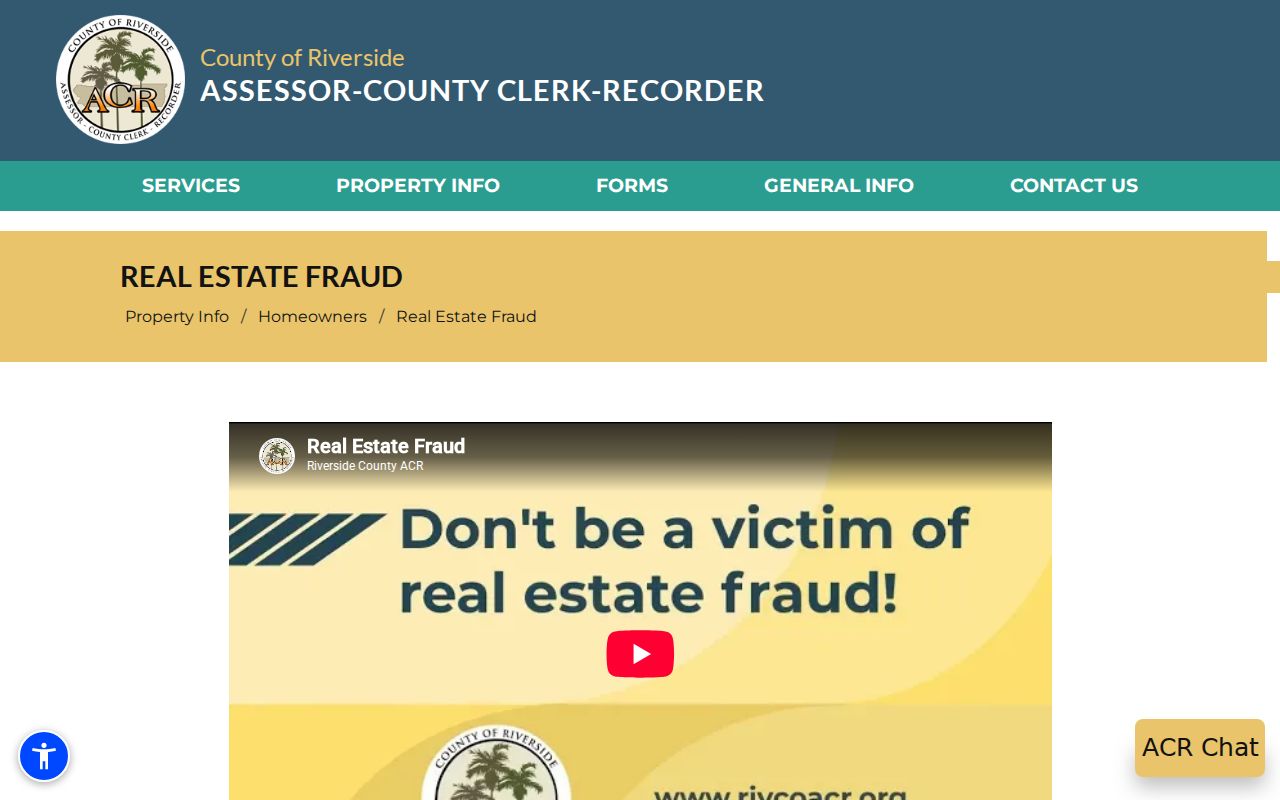
The warning is useful for neighbor research because a parcel number, deadline, or official-looking seal can still appear in a deceptive letter. Compare the document number, type, date, and parties with the county index before paying or sharing information.
| Source type | Strength | Limit and next step |
|---|---|---|
| Map or GIS | Shows physical adjacency, APNs, and jurisdiction layers | Not a people list; identify each parcel and confirm with the assessor |
| Assessor or recorder | Provides custodian-held parcel, owner, party, and document facts | Owner web suppression and party indexing require an office or name-based search |
| Commercial compilation category | May surface a name or address lead quickly | Merged identities and stale data require independent official verification |
Cathedral City Safe at Home Records
Some missing addresses are a privacy feature, not a search failure. California's Safe at Home program, under Government Code sections 6205 through 6216, gives qualifying survivors of domestic violence, stalking, sexual assault, human trafficking, elder or dependent-adult abuse, and certain reproductive-health workers or patients a substitute mailing address. It can include mail forwarding, a service-of-process agent, and confidential voter registration.
Enrollment is made through a designated enrolling agency, not by mailing an initial application directly to the Secretary of State. The program is prospective and does not sanitize old deeds or court records. Under section 6209.5, a participant may seek substitute-address use on certain deeds or changes of ownership, yet a legal description can still expose a property's location. Vital certificates are an exception. Questions go to 877-322-5227 or SafeAtHome@sos.ca.gov.
The California Safe at Home information explains the protected-address route that can affect a Cathedral City block search.
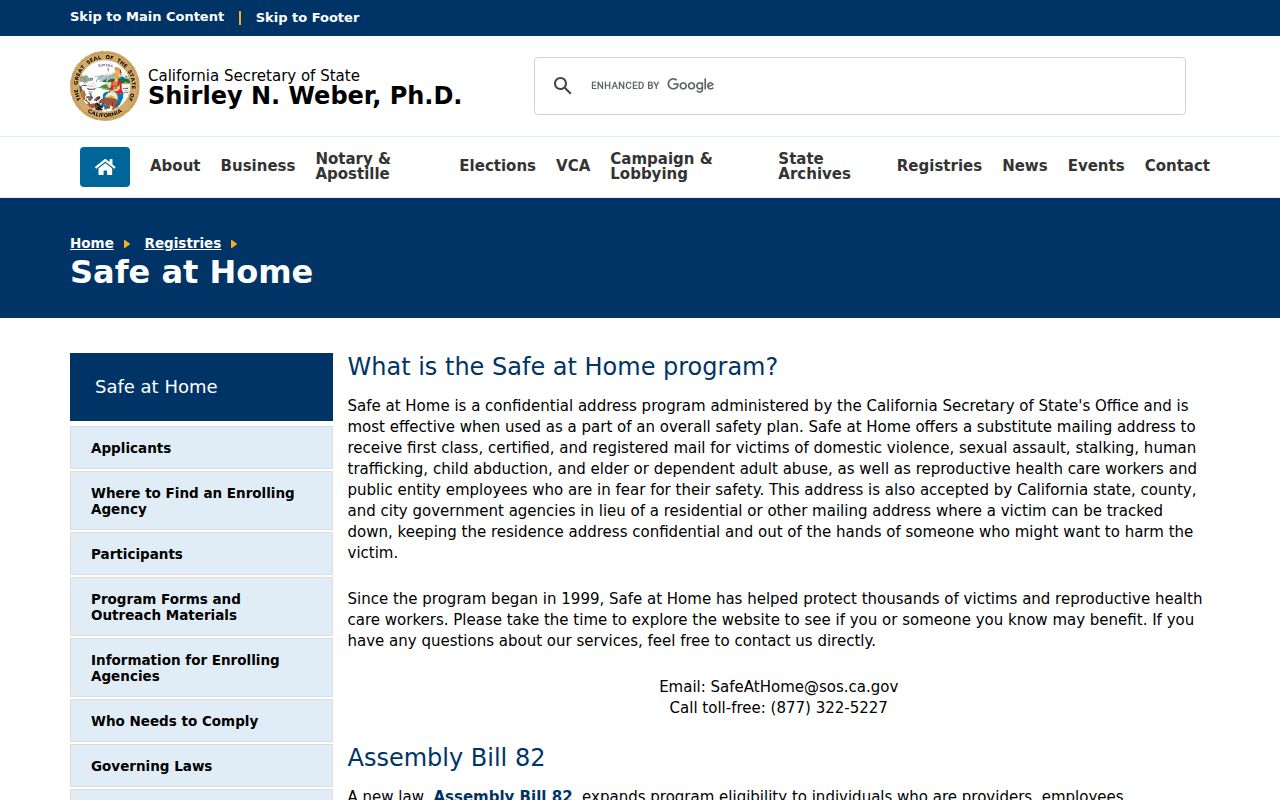
Do not treat an absent address as evidence that a person moved, left a block, or has no connection to it. The proper conclusion is that the public source has a protection or access limit.
Note: A missing public address may reflect a confidentiality program, not a move or a broken parcel search.
Privacy Limits for Cathedral City Neighbors
A block lookup can show land, public filings, and public contact points. It cannot expose DMV residence data, utility customer details, complete household membership, confidential voter information, or every protected resident. Public availability does not excuse stalking, harassment, voter-file misuse, or the improper use of motor-vehicle data. California Penal Code section 646.9 addresses stalking, section 653.2 addresses harmful electronic publication of identifying information, and Civil Code section 1708.7 provides a civil stalking action.
Use Cathedral City neighbors records for personal, lawful research, family reconnection, civic curiosity, and safety awareness. If a source is wrong, ask the custodian for its correction or access process. If the goal changes from the immediate block to a whole street, use the address and parcel method rather than trying to fill gaps with guesses.
Lawful personal use. A Cathedral City neighbors lookup should respect protected people and private household details. Do not use public records to stalk, harass, intimidate, or publish identifying information to cause unwanted contact.